
When your strategic initiativeis too important to competewith business as usual
An Executive Wingman adds dedicated senior execution capacity around a critical commercial initiative, so more of your ambition becomes reality without taking over leadership accountability.
Most leadership teams know what they need to do. The challenge is finding the bandwidth to do it all.
Change doesn't wait for spare capacity. The same leaders must deliver today's targets and build tomorrow's business, often through several critical initiatives at once. It is rarely a lack of ambition, strategy or competence. It is a lack of focused executive time.
of organisational transformations succeed in improving performance and sustaining the improvements.*
* Source: McKinsey & Company.
Five critical factorsAll must stay active at the same time
Transformations rarely fail on one factor alone. Value leaks when one of the five drops while the business is busy delivering. An Executive Wingman keeps all five in the air.
Plans, training and launches document completion. But that is not enough, because what really needs to change is behaviour. The Wingman defines the critical behaviours early and follows through until they actually change.
Even successful transformations realise only 67% of the potential; others 37%.1, 2
Day-to-day operations quickly reclaim the sponsor's attention, and people read that as a sign of whether the initiative still matters. Engaging a Wingman signals that it does. The Wingman acts on the sponsor's behalf every day and keeps follow-up and escalation on track. That addresses the biggest risk in any change, a lack of effective sponsorship.
79% with highly effective sponsorship met objectives versus 27% with highly ineffective sponsorship.3
Change meets resistance when objections go unheard. With a full agenda, few sponsors can stay close and focused enough to sense it in time. A Wingman has that focus. The Wingman listens early, acts on concerns and turns resistance into engagement, so the same people become the tailwind that carries the change.
Successful transformations show stronger involvement, with 82% vs 57% for line managers and 73% vs 46% for frontline employees.4
Each function, from product and marketing to SDR/BDR, sales and customer success, usually owns its part well. The hard part is making the parts work as one, and that takes time a full leadership agenda rarely has. The Wingman takes on that work, clears dependencies between teams and gets the decisions they need so momentum does not fade.
10 rather than 5 initiatives per owner was associated with +20 days’ delay and +40% value leakage.5 “Transformation cannot be a 5% job.”7
Attention declines after the intensive phase, and new routines can slip back. The Wingman reduces involvement gradually, tracks KPIs and behaviours, and phases out when impact is sustained internally.
Habit formation typically takes 66 days, but ranges from 18 to 254 days.6
Relevant when an initiative is critical, cross-functional and lacks a natural owner with enough bandwidth.
See how it works →Sources: 1 McKinsey & Company, Losing from day one: Why even successful transformations fall short. 2 Implement Consulting Group, Why transformation fails. 3 Prosci, Change Management Success. 4 McKinsey & Company, The people power of transformations. 5 McKinsey & Company, Seven percent solution? 6 Lally et al., Modelling habit formation in the real world. 7 Kvadrant Consulting, Kink the Curve. The research documents the mechanisms an Executive Wingman addresses, not a guaranteed outcome.
A new category of temporary support
Flexible execution when the need for change exceeds existing leadership bandwidth.
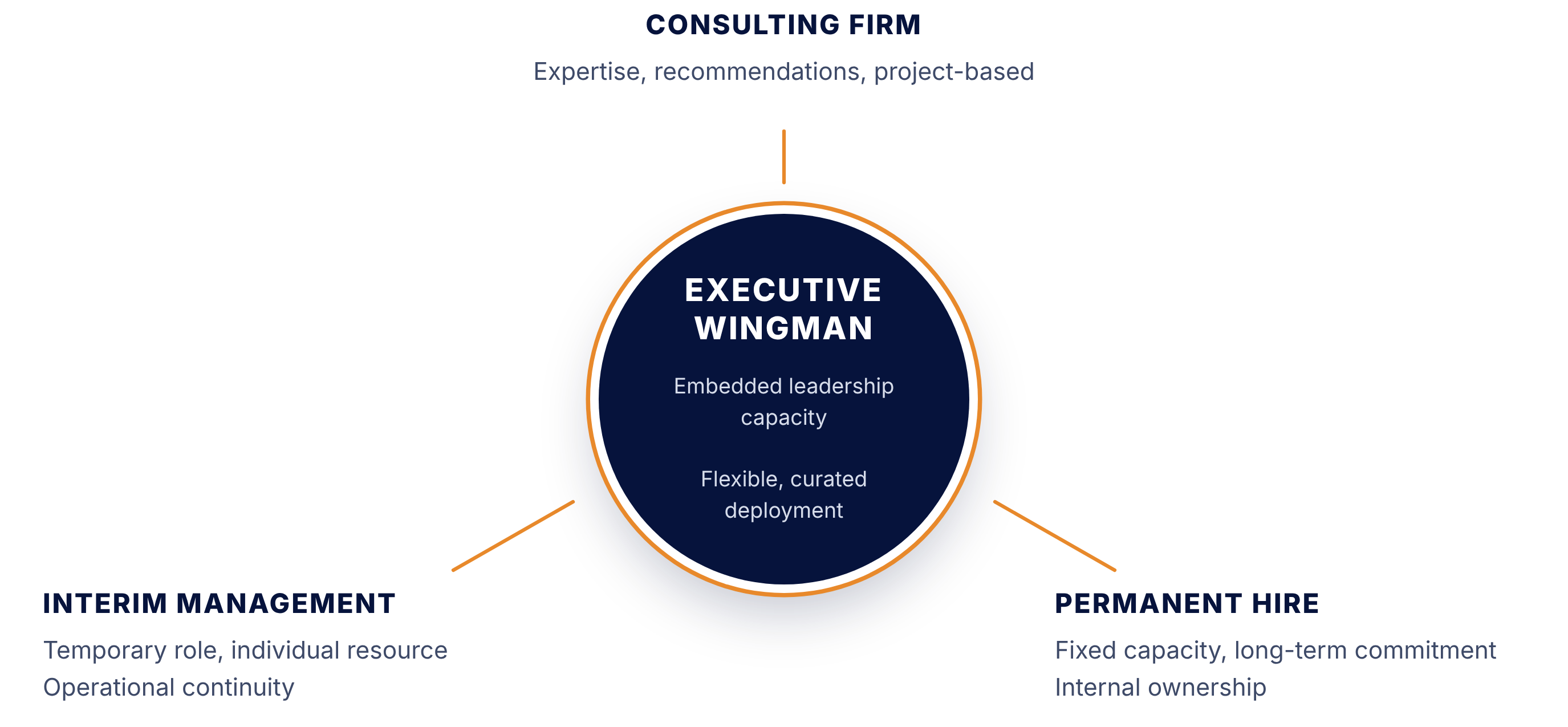
Interim fills an empty seat in the cockpit. A Wingman flies alongside a leader who is already there.
WINGMAN
Flexible, curated deployment
Operational continuity
Internal ownership
An Executive Wingman combines the flexibility and quality of consulting, the closeness of interim management and the accountability of executive leadership.
Wherever the commercial agenda outgrows leadership bandwidth
A Wingman can step into any critical commercial transformation. Explore illustrative strategic initiatives that may be relevant for your situation.

Commercial leaders with CXO experience and battle scars
Experienced executives who quickly understand the business, the people and the operational reality, and combine hands-on commercial leadership with a proven change management toolkit.
Meet the Wingmen →What is your critical strategic ambition?
Important. Cross-functional. Competing with business as usual. Let's talk about the mission.